
When Responsibility Slips Between Systems
A repost from my LinkedIn newsletter Thinking in Public. Reflections on Tiankai Feng’s "Humanizing AI Strategy" and the quiet ways responsibility disappears in modern AI work

Originally published in my LinkedIn newsletter Thinking in Public.
A review of Tiankai Feng’s Humanizing AI Strategy – a book about AI strategy that gradually reveals itself to be about something deeper: how responsibility moves, fragments, and sometimes disappears when systems begin to act on our behalf.
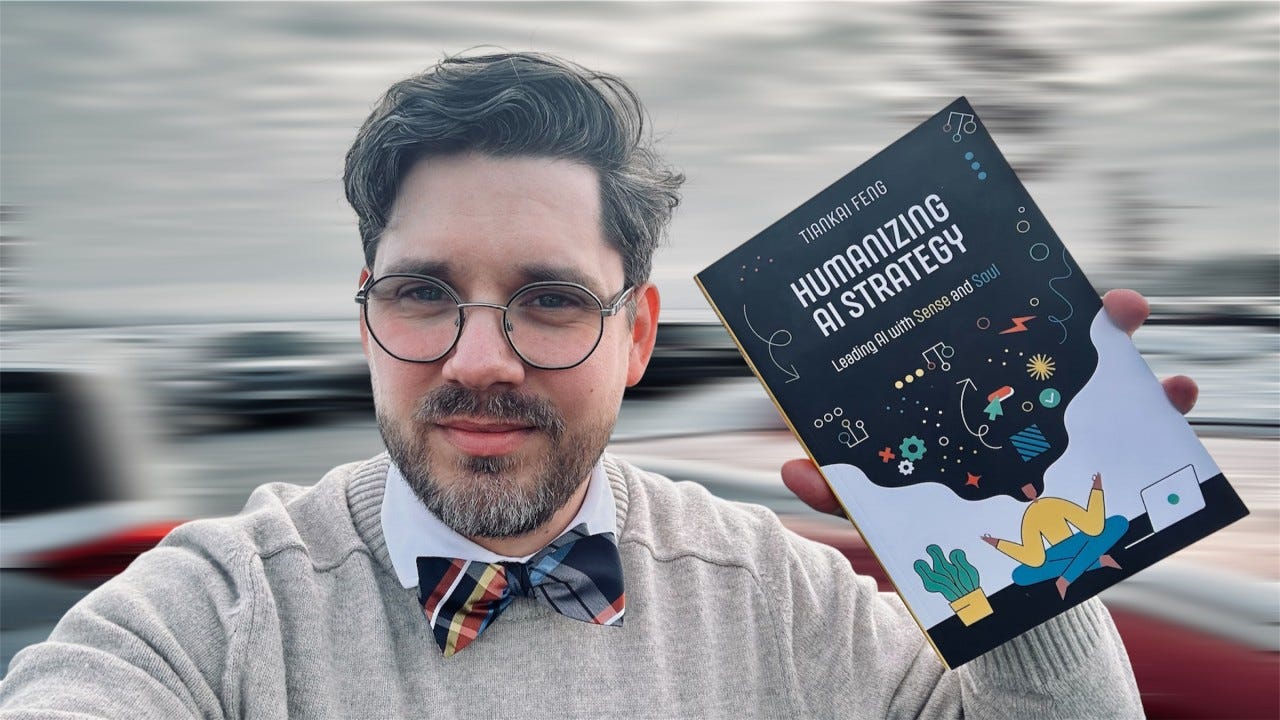
Tiankai Feng is one of those genuinely good people you occasionally meet in this field. He’s thoughtful, curious, and genuinely interested in exchanging ideas rather than just broadcasting them. He’s also someone with whom you can disagree without the conversation becoming hostile, which, in the current state of AI discussions, makes him rare. That matters more than it sounds.
There’s an optimism that runs through Feng’s work. You can feel it in his writing, on LinkedIn, and in conversation. I’ve always appreciated this quality in him. It’s not a manic, hyped-up optimism, but rather a more grounded belief that organizations can choose to act responsibly and that people usually want to do the right thing if given the right structures. I don’t always share the same level of optimism, which is probably why his optimism has such an impact on me. It gives me a boost every now and then.
So yes, I came to Humanizing AI Strategy with some skepticism. After all, it’s just another AI book. Another one promising to “put humans at the center.” I’ve read enough of those to know how easily human-centric language can become mere ornamentation – something we say after the architecture is already fixed. But my skepticism didn’t last long.
I had a similar experience when I read Feng’s previous book, Humanizing Data Strategy. What struck me then, and what strikes me again now, is that Feng doesn’t treat “the human” as a soft counterweight to technology. He treats humanity as the terrain that strategy must navigate. In the data book, this idea was expressed through stories of alienation, translation, and learning to bridge worlds. In the AI book, the lens has shifted, but the logic remains the same: systems fail when humans are absent, misaligned, or silenced.
What Feng does particularly well in Humanizing AI Strategy is to relocate responsibility. When AI fails, he argues, it is almost never because the math was wrong. Rather, it fails because humans were rushed, overconfident, poorly coordinated, or unwilling to ask uncomfortable questions. This framing matters. It resists the tendency to conveniently blame the model or the technology, instead insisting that strategy is a human act, even when execution is automated.
The book’s backbone is the 5Cs framework; Competence, Collaboration, Communication, Creativity, and Conscience. On paper, that could easily collapse into management shorthand. In practice, however, it works because it mirrors how organizations actually break down. Not due to a single bad system, but due to literacy gaps, siloed ownership, vague narratives, sameness disguised as efficiency, and moral ambiguity hidden behind speed. Feng is especially strong on competence, not as tooling proficiency but as judgment. AI literacy here isn’t about knowing how to prompt. It’s about knowing when to trust, when to question, and when to stop.
There is a clear throughline from the data book here. Where Humanizing Data Strategy focused on bridging gaps between technical systems and human meaning, Humanizing AI Strategy raises the stakes by acknowledging that AI does not just inform decisions, but rather, it acts. And once systems act, the cost of human absence rises sharply. Feng’s insistence on “the right human at the right time” is not a compliance mantra, but an architectural one.
I also appreciated what the book refuses to do. There’s no moral panic, no apocalyptic framing, and no GenAI hype. Generative models are treated as powerful, unstable, and context-sensitive, never as something magical. Traditional AI isn’t dismissed as obsolete. Human-in-the-Loop isn’t reduced to a checkbox. This is practitioner thinking, written by someone who has seen strategies fail for very human reasons: miscommunication, incentives pulling in different directions, and confidence outrunning competence.
If I have a point of friction, it’s a productive one. “Human-centric” can sometimes slide into the language of alignment rather than obligation. Conscience, as Feng presents it, is thoughtful and pragmatic, but I occasionally wanted it sharpened further. Less about balance, more about limits. Less about values, more about duties. That isn’t a flaw so much as a philosophical difference. Feng is building something organizations can realistically adopt. I am often more interested in what organizations must not do, even when it is efficient or profitable. Those perspectives are adjacent, not opposed.
Still, this is exactly the kind of book many AI leaders need right now. Not a technical manual. Not a regulatory checklist. And not an abstract ethics treatise. It’s a companion for people who sense that something important is at stake, but are tired of being told the answer is either “move faster” or “add more guardrails.
Like Humanizing Data Strategy, this book ultimately makes a quiet but firm claim: technology does not need to become more human. Humans need to remain present. Present in decisions. Present in language. Present in responsibility. In an age where fluent systems increasingly speak for us, that reminder is neither soft nor sentimental. It is strategic.